Why Multi-Day Vacation Rental Weddings Fail
Why multi-day weddings are hard at vacation rentals: the permit, insurance, and logistics traps, plus how to spot a wedding-approved property.

Multi-day weddings are hard at vacation rentals for one structural reason: the property is licensed, insured, staffed, and priced as a place to sleep, not as a place to hold an event. Everything that goes wrong downstream (the permit you find out about in month nine, the insurance certificate the owner suddenly needs, the DJ getting cut at 10 p.m., the caterer discovering there is no service door) traces back to that single mismatch.
The fix is not to avoid rentals. The fix is to book a property that has already crossed over from lodging to venue, and to know how to tell the difference before you send money.
I have coordinated over 200 wedding weekends across 14 states. The ones that came apart did not come apart because of taste or budget. They came apart because somebody assumed a house that sleeps 20 could automatically host 120 for three days. Those are two completely different operations.
Quick Navigation
- Why Multi-Day Weddings Are Hard at Vacation Rentals
- Problem One: The Property Is Licensed for Sleeping, Not Celebrating
- Problem Two: Permits and Noise Rules Write Your Timeline for You
- Problem Three: Insurance Requirements Arrive Late and Land Hard
- Problem Four: Logistics Compound Across Three Days
- Problem Five: Vendors Hit a Property With No Back of House
- How to Identify a Wedding-Approved Property
- The Questions to Ask Before You Send a Deposit
- When a Rental Weekend Is Still the Right Call
Key Takeaways
- Vacation rentals are licensed for overnight lodging, not assembly, so weddings usually need a separate special event permit.
- The Knot's 2026 study of 10,474 couples found 117 average guests and 13 hired vendors, meaning 13 separate arrivals and parking spots.
- Sonoma County sets 10 p.m. to 7 a.m. quiet hours, bans outdoor amplified sound entirely, and cuts the decibel limit 5 dBA for music.
- Event liability coverage starts near $75 to $119 for up to $2 million per occurrence, rounding error against a $34,200 average wedding.
- Septic systems sized for sleeping occupancy fail under 120 guests, so budget restroom trailers above roughly double the sleeping capacity.
Why Multi-Day Weddings Are Hard at Vacation Rentals
Short version: a vacation rental is built around a small group that arrives quietly, stays inside, and leaves. A multi-day wedding is the opposite. It triples the headcount, brings in commercial vehicles, generates amplified sound, runs past quiet hours, and repeats all of that for two or three consecutive days. Local rules, insurance policies, and the physical building itself are all sized for the first scenario.
Here is the game plan for the rest of this piece: five specific failure points, then a method for spotting a property that has already solved them.
Okay, so a little context on scale first, because most couples underestimate what they are actually asking a house to absorb. The Knot's 2026 Real Weddings Study, which surveyed 10,474 US couples who married in 2025, found the average wedding guest count is 117 and the average couple hires 13 wedding professionals. Thirteen. That means thirteen separate vendor arrivals, thirteen sets of gear, thirteen parking spots, thirteen people who need somewhere to change or eat or plug in a charger. A rental designed for a family of twelve has parking for four cars and one circuit that trips when you run two coffee makers.
Now stretch that across three days. Friday welcome dinner, Saturday ceremony and reception, Sunday brunch and load-out. Each day has its own arrival wave, its own trash volume, its own noise curfew, its own cleanup. The load does not average out across the weekend. It stacks.
Real talk: the couples who get burned are almost never careless. They are usually the most organized people in the room. They just asked the wrong question up front. They asked "can we fit everyone?" when the question is "is this property permitted, insured, and equipped to run an event?"
Problem One: The Property Is Licensed for Sleeping, Not Celebrating
Most short-term rentals operate under a lodging license. That license covers overnight occupancy. It does not cover assembly, which is the legal category weddings fall into in a lot of jurisdictions.
Look at how a real county writes this. Sonoma County's vacation rental code (Sec. 26-88-120) states plainly that use of a vacation rental is subject to performance standards including noise and occupancy limits, and that most special events require a separate special event permit. Not a suggestion. A separate application, with its own review, its own timeline, and its own conditions.
Pinellas County, Florida adopted a short-term rental ordinance requiring owner-operators to obtain a Certificate of Use and follow safety, parking, and noise regulations. Hollywood, Florida runs a Vacation Rental License Program with occupancy caps tied directly to the license. These are three counties picked more or less at random. Multiply that by the fact that every municipality writes its own version, and you can see why "we checked, it's fine" is not a real answer.
There is a second layer here that catches people. The big mainstream rental listing platforms mostly prohibit events outright. Their host policies were written to stop party houses, and the language is broad enough to sweep up a 100-person wedding along with a rager. So an owner who wants to say yes to your wedding is often taking on platform risk on top of municipal risk. Some will do it quietly and hope nobody notices. That is the version that gets shut down mid-weekend.
I have seen this go wrong exactly once in a way I still think about. A couple booked a beautiful lakefront place, got a verbal yes from the owner, and got a code enforcement visit on Saturday afternoon. Ceremony happened. Reception got moved to a restaurant 20 minutes away at 4 p.m. on the day of. Everyone was gracious about it. Nobody forgot it either.
What this means for you: the owner's permission is necessary and nowhere near sufficient. You need the property's event standing to be documented, not verbal.
Problem Two: Permits and Noise Rules Write Your Timeline for You
This is the part that surprises couples most, and it is the reason I build the timeline backward from the local sound curfew rather than forward from the ceremony.
Quiet hours are not a courtesy. They are usually written into the same ordinance that permits the rental to operate. Sonoma County sets quiet hours from 10 p.m. to 7 a.m. and, in the relevant permit conditions, requires notification that no outdoor amplified sound is allowed at all. Pinellas County quiet hours run 10 p.m. to 9 a.m. Hollywood, Florida sets them at 11 p.m. to 6 a.m.
Read that Sonoma line again, because it is the sneaky one. No outdoor amplified sound, period, is a different rule from a curfew. A curfew means your band stops at 10. A no-amplified-sound condition means your band never plays outside at all.
It gets more technical. Sonoma's code reduces the applicable decibel standard by five dBA for noises consisting primarily of speech or music, and for recurring impulsive noises. In plain English: music is held to a stricter threshold than general ambient sound. A toast on a microphone counts. So does a dance floor.
The enforcement mechanics matter too. Under that same Sonoma section, a certified property manager must be reachable 24 hours a day whenever the property is rented and must correct a reported problem within 60 minutes, or within 30 minutes during quiet hours. If the permit gets revoked over violations, the property cannot reapply for at least one year. That is an owner with a very strong incentive to shut your reception down at 9:59 rather than argue with you.
So here is how the timeline actually gets built:
- Find the local quiet hour. Call the county planning or code enforcement line and ask directly. Do not rely on the listing.
- Confirm whether outdoor amplified sound is allowed at all, and at what hour it has to stop.
- Back the last dance up to 30 minutes before that cutoff. You want buffer, not a photo finish.
- Back the reception start up from there, then dinner, then ceremony.
- Decide where the after-party goes. Indoors with doors closed, off site, or nowhere.
This is non-negotiable: you build the weekend around the sound rule. Not the other way around. Couples who plan a 10:30 p.m. sparkler exit and then discover the curfew in April are the ones rewriting an entire day in a panic.
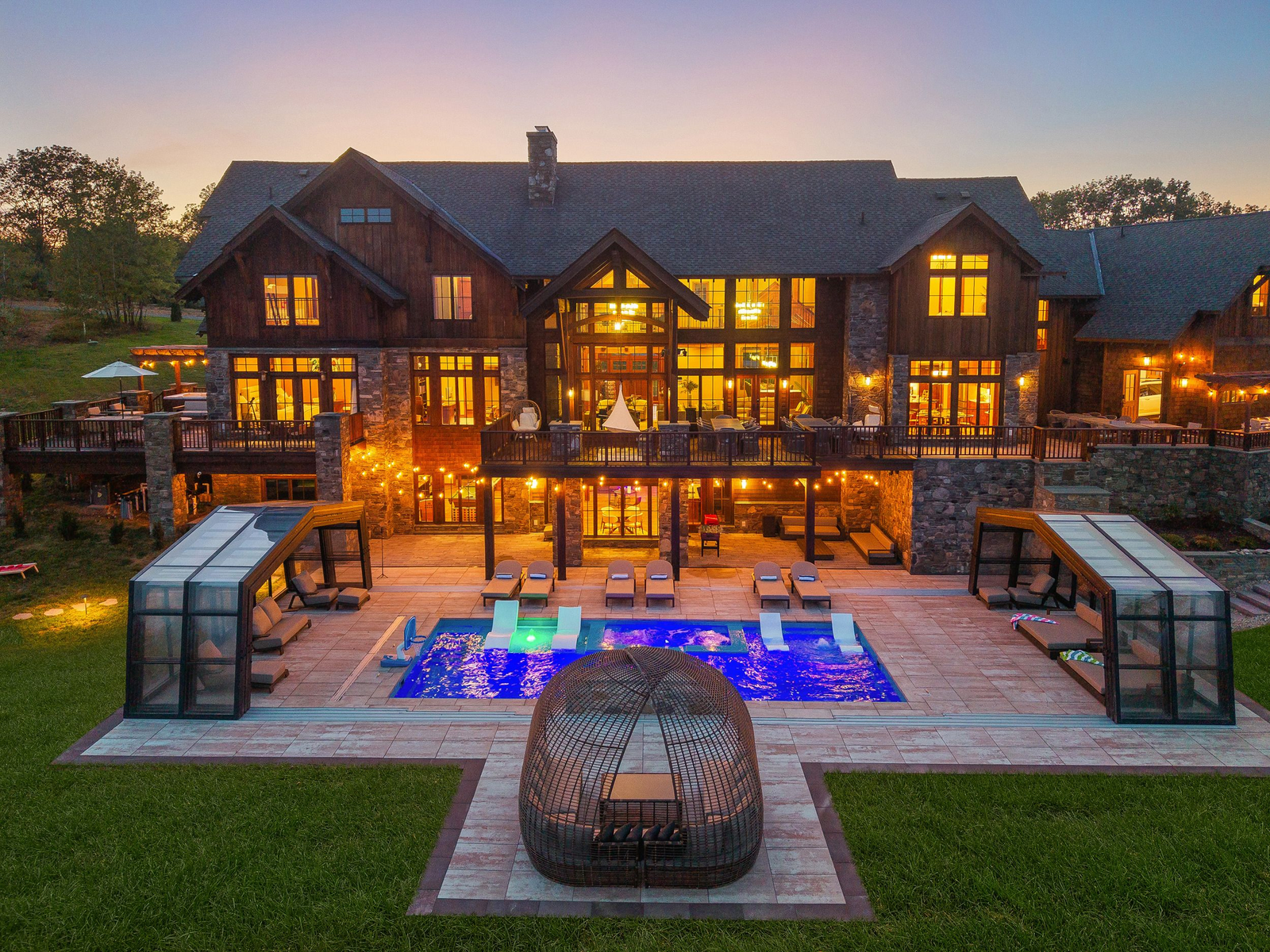
Properties with indoor event space give you a real escape valve here. A place like this 65-acre contemporary lake estate in Monrovia, Indiana with a full atrium and resort-style indoor pool lets you move a dance floor inside when the sound rule (or the weather) says outdoor is finished. That optionality is worth more than an extra acre of lawn.

Problem Three: Insurance Requirements Arrive Late and Land Hard
Nobody thinks about insurance in month two. Almost everybody is thinking about it in month ten, usually because an owner or a vendor asked for a certificate.
The good news: event liability coverage is not expensive relative to a wedding budget. GEICO advertises wedding and event insurance starting at $75. The Knot reports event-liability coverage starting around $119 with zero deductible, providing up to $2 million per occurrence and $3 million aggregate. CNBC Select, citing The Knot's data, puts basic liability plus cancellation coverage at an average of $75 to $550, with more elaborate events running higher.
The bad news is everything around it:
- The owner may need their own coverage, not just yours. A standard short-term rental policy frequently excludes commercial or event use. If the owner's carrier finds out a wedding happened, the property can be uninsured for the exact event you are hosting.
- Vendors have their own certificate requirements. Caterers, bar services, and tent companies routinely need to be named as additional insureds, or they need the venue to carry a minimum limit. A private residence often cannot satisfy that.
- Alcohol changes the math. Host liquor liability and licensed bar service are different products with different requirements, and a lot of counties treat serving alcohol at a permitted event as its own approval.
- The certificate has to name the right entity. I have watched a certificate get rejected two days out because it named the couple and not the LLC that owns the property.
Confession time: I messed this up early in my career. I assumed a policy purchased in the couple's name would satisfy a property owner's lender requirement. It did not. We got it fixed in 36 hours with a lot of phone calls and one very patient underwriter, but I have run insurance as a month-three task ever since, not a month-ten one.
Budget context helps here. The Knot's 2026 study puts the average wedding at $34,200 with an average cost per guest of $292. A $200 to $400 insurance line item against a $34,000 event is rounding error. The cost of skipping it is not.
Problem Four: Logistics Compound Across Three Days
Single-day weddings are a sprint. Multi-day weddings are a supply chain. This is the part where my old job keeps showing up in my new one, and honestly the parallels are uncomfortable enough that I try not to lean on them too hard, but the core lesson transfers: sustainment is harder than the assault, and the thing that kills you on day three was a small decision on day one.
In my 200+ wedding weekends, three things ruin a multi-day celebration: bad timelines, no contingency plan, and not enough bathrooms. All three get worse with duration, not better.
Waste. A hundred guests generate a real volume of trash and recycling per day. Residential trash service runs on a weekly pickup. Nobody is coming Saturday night. Where does three days of catering waste physically sit, and who hauls it Sunday?
Water and septic. Many rural estates run on well and septic rather than municipal utilities. Septic systems are sized for the sleeping occupancy, not for 120 people using bathrooms across an eight-hour reception. This is the single most common cause of a genuinely miserable Saturday night, and it is the reason portable restroom trailers exist. Budget for them at any headcount above roughly double the sleeping capacity.
Power. Residential electrical panels are not built for a band, commercial catering equipment, string lighting, and a coffee station simultaneously. Ask for the panel amperage and whether there is a generator tie-in. If the property has hosted events before, the owner will know this number instantly. If they have to go look, that tells you something.
Parking and access. Thirteen vendors plus guests who did not carpool equals a lot of vehicles on what may be a single-lane gravel drive. A box truck that cannot turn around is a genuine emergency at 2 p.m. on a Saturday.
Guest fatigue. This one is not operational, it is human, and I care about it more than the rest. Three days is a long time to be "on." Your guests need unstructured hours built into the schedule, and they need to be able to retreat somewhere. Programming every waking minute of a weekend is the fastest way to have exhausted people at your reception.

Lodging math. Here is where the budget quietly moves. If the estate sleeps 16 and you have 45 people who need beds, the remaining 29 are booking hotels 25 minutes away, which means shuttles, which means a transportation line item and a departure schedule and someone sober enough to manage it at midnight. Properties with genuine on-site capacity change this equation entirely. The Hudson Valley historic estate in Sparrow Bush, New York carries an on-site inn alongside the main house, and a private 80-acre Georgia estate in Thomasville spreads 30 beds across four separate homes and twelve suites. More beds on site means fewer shuttle runs, fewer late-night drives, and a materially cheaper weekend.
Problem Five: Vendors Hit a Property With No Back of House
A commercial venue has a back of house. Prep kitchen, service corridor, loading area, staff restroom, a place to stage 120 plates. A house has a kitchen designed for one person making dinner.
What caterers actually need, and what most rentals do not have:
- A prep surface long enough to plate in a line, not a kitchen island with a fruit bowl on it
- Refrigeration beyond a single residential fridge already full of the wedding party's groceries
- A service path from prep to guests that does not run through the room where people are dancing
- Somewhere to wash and stack, and somewhere to stage dirty dishes out of sight
- Restroom access for staff that is not the guest line
When those are missing, caterers either decline the job or price in the workaround: a tented prep area, rented refrigeration, extra staff to walk longer distances. That is a real cost increase and it belongs in your budget from the start.
Same story on the vendor side more broadly. A DJ needs to know where the power is. A florist needs a shaded staging area and a water source. A photographer needs to know if there is a room to leave gear in. None of this is exotic. It is just the stuff that a purpose-built venue solves invisibly and a house does not.
Wait, I should mention the other half of this: vendor familiarity. A vendor who has worked a specific property before arrives knowing the drive, the power, the noise cutoff, and where the bugs get bad at dusk. A vendor who has never seen it is solving all of that live, on your day. Booking from a pool of multi-day and weekend specialists rather than single-day vendors is one of the highest-use decisions available to you, and it costs nothing extra.

How to Identify a Wedding-Approved Property
Here is the method. It is not complicated, it is just specific, and most couples skip steps two and four.
1. Look for event language in the listing, not just event photos. A property that hosts weddings says so. It quotes an event guest maximum that is different from the sleeping capacity. It mentions ceremony sites, event lawns, dedicated event space. A listing that shows a pretty lawn but never uses the word "event" is a lodging listing.
2. Confirm the event capacity number exists and is separate from sleeping capacity. This is the single fastest tell. "Sleeps 24" is a lodging spec. "Sleeps 24, hosts 150" is a venue spec. If the owner cannot give you an event capacity number, the property has probably never been evaluated as a venue.
3. Ask what permit the property holds and whether a per-event permit is still required. The three good answers are: the property holds a standing event or assembly permit, the property is on land zoned to allow events, or the owner routinely pulls a special event permit and knows the lead time. Any of those is workable. "We've never had a problem" is not an answer.
4. Verify insurance in both directions. The owner should be able to tell you what event coverage they carry and what certificate they need from you, with the correct named entity. If they have hosted before, they have a template. If they have not, you are the test case.
5. Check the infrastructure specs. Septic versus municipal sewer. Panel amperage and generator access. Parking count. Number of restrooms. Whether there is an indoor space large enough for the full guest count if the weather turns.
6. Ask for the noise rule in writing. Not "quiet hours are around ten." The actual ordinance, the actual hour, and whether outdoor amplified sound is permitted.
7. Ask who is on site and reachable during the event. Many jurisdictions require a responsible party available within 30 to 60 minutes. Know who that is and have their number.
8. Ask for two references from past weddings. Not reviews. Phone references from couples who ran a multi-day event there. Ten minutes on the phone with someone who did this last summer is worth more than any amount of listing copy.
A platform that vets for event use handles a chunk of this before you ever see the listing. That is the whole reason WedStay's multi-day wedding venue collection exists as a separate category: every property in it is listed specifically to host a wedding weekend, with an event capacity, not just a bed count. If you would rather narrow by your own guest count and dates first, the venue matcher does that filtering for you.
The Questions to Ask Before You Send a Deposit
Copy these into an email. Send them before the deposit, not after. In my experience a couple reviewing a property properly generates somewhere between 20 and 60 individual questions, so this is a starting set, not a complete one.
Permitting and policy
- Is this property permitted for events, and under what license or zoning?
- Do we need a separate special event permit, and what is the lead time to get one?
- What is the maximum event guest count allowed by permit, not by preference?
- Are there restrictions on ceremony location, tenting, or temporary structures?
Sound
- What are the local quiet hours, and can you send the ordinance section?
- Is outdoor amplified sound permitted, and until what time?
- Has a neighbor ever filed a noise complaint about this property?
Insurance and liability
- What event coverage do you carry, and what certificate do you need from us?
- What entity name should appear on the certificate?
- What are your rules on alcohol service, and do you require licensed bartenders?
Infrastructure
- Is the property on septic or municipal sewer, and what is the rated capacity?
- What is the electrical panel amperage, and is there generator access?
- How many vehicles can park on site, and where do vendor trucks stage?
- Is there an indoor space that fits our full guest count if it rains?
Timing and access
- What is the total cost for the minimum stay we need, and is a third night available?
- What time can vendors access the property on setup day, and when is load-out due?
- Who is the on-site or on-call contact during the weekend?
- Can you connect us with two couples who held multi-day weddings here?
If a property owner answers all eighteen without hesitating, you have found a venue. If they get vague around four through nine, you have found a house. Both can be lovely. Only one of them should host your wedding.
For the full weekend-level sequencing (arrival waves, welcome dinner, rehearsal, day-after brunch), the wedding weekend planning guide walks the whole three-day structure rather than just the venue decision.
When a Rental Weekend Is Still the Right Call
I have spent this whole piece on what goes wrong, so let me be fair about what goes right, because I would not have built a firm around wedding weekends if the format did not work.
A property weekend is the right call when:
- Your guest count is genuinely private. Under about 60, most of the infrastructure pressure drops away and the intimacy advantage is enormous.
- You want time, not just a day. The single best thing about a multi-day wedding is the Saturday morning coffee on a porch with people who flew in from four time zones. You cannot buy that at a hotel ballroom.
- Lodging and venue overlap heavily. When most of your guests sleep on site, you delete transportation, you delete the 11 p.m. shuttle problem, and the weekend gets both cheaper and calmer.
- The property has already done this. A place that has hosted twenty weddings has solved the septic, the parking, the power, and the noise rule. You are inheriting those solutions.
The things I remember most about the weekends I have run are not the ones with the biggest floral budgets. They are the ones where the logistics were boring, because boring logistics mean everyone got to actually be at the wedding. That is the entire goal.
So the honest answer to "why are multi-day weddings hard at vacation rentals" is that they are hard when you rent a house and ask it to be a venue. They are not particularly hard when you book a property that is already a venue and happens to have beds. Do the diligence up front, ask the eighteen questions, and the difficulty mostly disappears before it ever reaches your weekend.
Free Tools to Build Your Vendor Team
Finding the right vendors for a private property wedding takes specialized expertise. WedStay makes it simple.
🎯 Start PlanningBrowse Vetted Vendors, Only 15% of applicants accepted. 500+ vetted professionals across photographers, planners, caterers, and 8 more categories.Wedding Budget Planner, See exactly how much to allocate per vendor category based on your location and guest count.Wedding Venue Cost Calculator, Includes vendor add-on pricing for catering, DJ, flowers, hair & makeup, and more by region.Get the Free WedStay App, browse venues, plan, and book on the go.
Related guides:
- How WedStay Works: A Step-by-Step Guide to Planning Your Short Term Rental Wedding
- 10 Things Every Couple Should Talk About After Getting Engaged (Before You Pick the Cake)
Frequently Asked Questions
Can you hold a ceremony and reception at a vacation rental, and what vendor problems come up when you don't own the property?
You can, but only if the property has real event standing, not just an owner's verbal yes. The vendor problems are the ones people underestimate: caterers and bar services often need to be named as additional insureds or need the site to carry a minimum liability limit, and a private residence frequently cannot satisfy that. Certificates get rejected for naming the couple instead of the LLC that owns the property. Tent companies want load-in access a single-lane gravel drive may not offer. And the risk couples raise most often is cancellation: without a venue contract, an owner can walk away from the booking, so get the event terms in writing.
Can you host a wedding at a vacation rental or cabin, and what should you know before doing it?
Yes, if you book a property that has already crossed from lodging to venue. Before you send money, get three things in writing: the property's event permit standing with the county, whether outdoor amplified sound is allowed at all and until what hour, and the owner's own insurance position, since standard short-term rental policies frequently exclude event use. Then ask the practical questions: panel amperage, generator tie-in, septic capacity, parking count, and where three days of catering waste sits before Sunday. An owner who has hosted events knows the amperage instantly. One who has to go look has told you something.
What does it actually cost to add event liability insurance to a wedding at a rental property?
Not much relative to the event. GEICO advertises wedding and event insurance starting at $75. The Knot reports event liability coverage starting around $119 with zero deductible, up to $2 million per occurrence and $3 million aggregate. CNBC Select, citing The Knot, puts basic liability plus cancellation coverage at an average of $75 to $550, higher for elaborate events. Against The Knot's $34,200 average wedding, a $200 to $400 line item is rounding error. Buy it in month three, not month ten, because the fix takes phone calls you do not want to make two days out.
How many portable restrooms do you need for a wedding at a house with a septic system?
The rule of thumb from the post's logic: budget for a restroom trailer any time your headcount runs above roughly double the property's sleeping capacity. A house that sleeps 20 has a septic system sized for 20 people over a slow week, not 120 people across an eight hour reception. That mismatch is the single most common cause of a genuinely miserable Saturday night. Trailers with sinks and lighting read far better than construction units, and they take load off the house's plumbing for the whole weekend, not just reception hours.
How should short-term rental hosts handle wedding groups that break guest and vehicle limits, and what can be done about retaliatory reviews?
Put the limits in the listing and the booking agreement with a specific number, not a vague reference to occupancy, and state the per-vehicle and per-extra-guest consequence in advance. Enforce it at check in, in writing, with timestamps and photos, before anyone unloads. That paper trail is what a platform actually reviews. On retaliatory reviews, the documented policy violation is your use: platforms will typically remove a review tied to a guest penalized for breaking stated house rules, but only when the violation is logged contemporaneously. The stakes are real for the host too. In Sonoma County a revoked permit cannot be reapplied for at least a year.
What questions should you ask a county before booking a rental for a wedding weekend?
Call the planning or code enforcement line, not the listing agent, and ask five things: does this parcel need a special event permit, what is the review timeline, what are the quiet hours, is outdoor amplified sound permitted at all, and is there a decibel standard specific to music or speech. That last one matters. Sonoma County reduces the applicable standard by five dBA for noise that is primarily speech or music, so a toast on a microphone is held to a stricter threshold than ambient sound. Quiet hours vary widely: Sonoma runs 10 p.m. to 7 a.m., Pinellas 10 p.m. to 9 a.m., Hollywood 11 p.m. to 6 a.m.
Sources
1. Wedding Checklists & Timeline · marthastewart.com
2. 45 Questions to Ask a Wedding Venue During Your Tour · theknot.com
3. The Ultimate Wedding-Day Checklist · marthastewart.com
4. How to Book a Honeymoon Along the California Coast Using Points · cntraveler.com